by Styliana Pasiardi, Policy and Campaigns Manager
Introduction
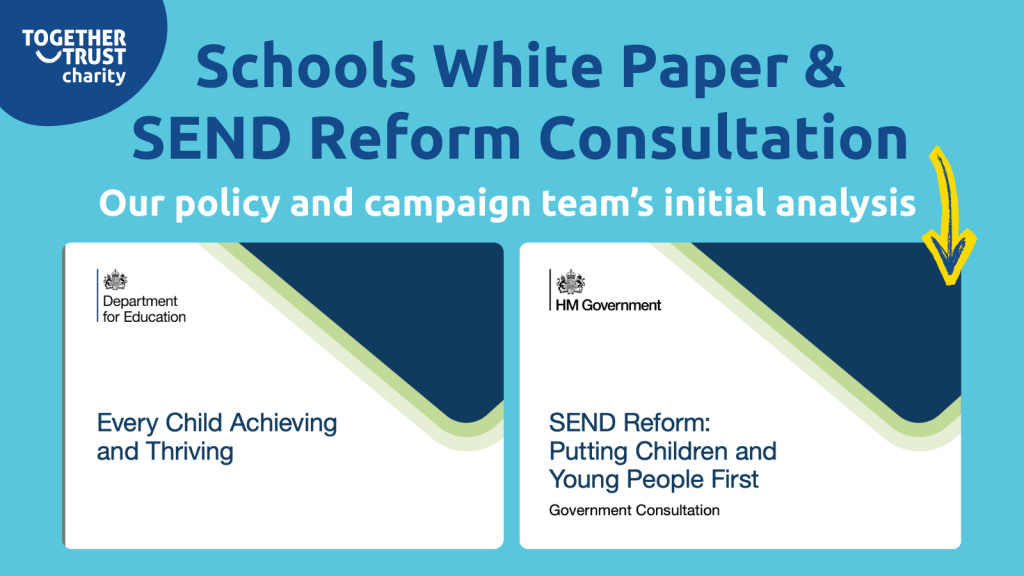
The government has published two major documents setting out the future direction of education and support for children and young people with special educational needs and disabilities (SEND):
- Schools White Paper Every Child Achieving and Thriving (Feb 2026)
- SEND Reform Consultation Putting Children and Young People First
There are no immediate legislative changes. The Schools White Paper sets out the Government’s long‑term vision for the school system, while the SEND Reform Consultation details proposed changes to SEND processes, pathways and legal duties. Together, they outline significant changes to how mainstream settings, special settings, local authorities and health partners may work with children and families in the coming years.
The SEND Reform consultation is open until 11:59 on 18 May 2026. Anyone can share their views directly via the Government’s consultation page.
In this blog, we outline the key proposals and what they could mean in practice for children, young people and families.
Our initial analysis is informed by years of lived‑experience evidence from children, young people and families, alongside insight from colleagues and external partners.
Over the coming weeks, we will continue gathering views from across the charity to shape our formal response.
Our analysis
Early identification
What the Government says
The government plans to expand early identification through:
- new tools
- increased investment in Best Start Family Hubs (each with a SEND practitioner)
- updates to the SEND Code of Practice with new “areas of development” to guide professionals(Executive Function, Motor and Physical, Sensory, Speech, Language and Communication, Social and Emotional).
Our view
Early identification is welcome, but only meaningful if children can access specialists quickly. Families report long waits even after needs are recognised. Investment must be matched with timely, consistent specialist provision.
Inclusive education and mainstream support
What the Government says
- £4bn investment to strengthen inclusive practice in mainstream schools.
- A statutory Individual Support Plan (ISP) for every child with SEND.
- Proposed shift to a revised complaints‑based mechanism.
- A new four‑tier model: Universal, Targeted, Targeted Plus, and Specialist.
Our view
Strengthening inclusion is positive, but must be backed by resources. ISPs could risk becoming resource‑led rather than needs‑led if the system lacks capacity.
Families need clarity about what each tier guarantees, who monitors delivery, and how they can challenge insufficient support. Proposed changes to complaints processes risk placing too much accountability on schools without providing families with effective routes to redress.
Special settings, EHCPs and Specialist Provision Packages
What the Government says
- New Specialist Provision Packages defining “complex needs”, though the criteria will be developed by an expert panel.
- EHCPs issued only after a child is matched to one of these packages.
- EHCP reviews replaced with reassessments only at key transitions.
- A fast‑track route for children under five with complex needs.
- Possible shift of responsibility for delivering EHCP provision from local authorities to schools.
Our view
These proposals could weaken legal protections.
Families need clear definitions of “complex needs” and transparent thresholds. Reducing annual reviews risks missing vital changes in need, losing appeal opportunities, and limiting accountability for health and social care partners.
The potential transfer of EHCP delivery responsibility to schools could make enforceability harder, particularly where provision is missing or delayed.
Join‑up across services
What the Government says
- New local partnerships with shared accountability.
- Improved multi‑agency support, stronger social care input, and designated social care officers.
- Schools integrated as the fourth safeguarding partner.
- £1.8bn Experts at Hand service offering easier access to EPs, SaLT, OTs and other specialists.
- Partnerships across mainstream, special schools and alternative provision.
Our view
A joined‑up system is vital. All relevant agencies must participate consistently in EHCP reviews, regardless of perceived progress. Collaboration between schools and local authorities must become the norm, not the exception. Best practice sharing should be national and systematic.
Workforce
What the Government says
- Increased investment in SENDIASS and parent carer forums.
- Reviewing and strengthening the SENCO role.
- Recruitment of over 200 more educational psychologists annually from 2026.
- Expanded access to specialist therapists through Experts at Hand.
Our view
A strong, skilled workforce is the backbone of an effective system. SENCOs need protected time, training and manageable workloads. Existing shortages in therapy and specialist roles could undermine early identification and timely support unless reform includes long‑term workforce planning and investment.
Mediation and SEND Tribunal
What the Government says
- Strengthened, independent mediation.
- Considering limiting SEND Tribunal powers, including the ability to name specific schools.
- Councils to provide recommended placement lists.
- No duty to name full schools in EHCPs if that school is already full. Emphasis on “value for money”
Our view
Tribunal rights must not be weakened. Many families secure essential provision only through the Tribunal, given councils’ high failure rate in appeals. Any reduction in Tribunal authority risks leaving children in unsuitable settings without effective remedy.
Funding Reform
What the Government says
- Pooled budgets and new conditions on SEND spending.
- Schools required to publish Inclusion Strategy Reports.
Our view
Funding must remain needs‑led. Predetermined funding bands may not reflect children with multiple or overlapping needs.
Best practice and inclusive standards
What the Government says
- National guidance to strengthen inclusion.
- More inclusion bases across schools.
- Curriculum adaptations and evidence-led tools.
- Emphasis on reasonable adjustments without requiring diagnosis.
Our view
This focus is welcome, but the gap between guidance and reality is large. Without addressing workforce shortages, schools will struggle to implement inclusive practice consistently.
Attendance and Emotionally-Based School Avoidance
What the Government says
A major push to increase attendance nationally.
Our view
This risks overlooking the growing issue of EBSA. Families tell us their concerns are dismissed or misunderstood. Enforcement-led approaches may harm children whose needs make school attendance unsafe or unmanageable.
Transport
What the Government says
Transport is noted briefly in the Schools White Paper but not addressed at all in the SEND consultation.
Our view
Transport must be statutory up to age 25, processed quickly, and properly funded. Delays or refusals prevent many young people from accessing education.
Transitions and Post‑16 Support
What the Government says
- Improved transition planning across services.
- New post‑16 routes (Level 1 stepping‑stone qualifications, updated Level 2, new Level 3 V Levels).
- Greater visibility of disability in the curriculum.
Our view
Transitions must start early – ideally by Year 9 – and include education, social care and adult services. Post‑16 pathways must value academic, vocational and life‑skills learning equally.
Support must extend beyond education to prevent young people becoming isolated after leaving school.
Simplifying SEND Information
What the Government says
- Better coordinated information via Family Hubs.
- Annual Inclusion Strategies from schools.
- Funding for SENDIASS and parent carer forums.
Our view
Information must be clear, centralised and genuinely accessible. Families should not have to navigate a maze to find out what help exists.
Legislation
What the Government says
The government states that no changes to support delivered through EHCPs will happen before at least September 2030. It plans to update the SEND Code of Practice, adding new “areas of development” to guide educators, with a full revision following any legislative changes.
Legislation will be brought forward as soon as possible, with Specialist Provision Packages forming the basis of future EHCPs across mainstream and specialist settings.
The government may also revise legislation to ensure SENCOs and other professionals have the appropriate training and experience for their evolving roles.
In addition, it proposes requiring all schools to join and form a Local SEND and pool a proportion of their funding.
Our view
Core legislation – the Children and Families Act 2014 and the SEND Code of Practice – must be applied consistently, and children’s rights must not be weakened through these reforms.
Duties under the Equality Act 2010 must remain central: reasonable adjustments should never depend on diagnosis or budget pressures. Children and young people should also play an active, meaningful role in shaping their plans and the support they receive.
Positives
There are several welcome commitments across the proposals.
These include stronger recognition of the role that special schools and specialist FE play in improving outcomes, alongside improvements in early identification, more inclusive mainstream support, and expanded access to specialist services without an EHCP.
Additional funding for SENDIASS and parent carer forums, and strengthened independent mediation services is positive, as is the focus on post‑16 pathways, faster access to specialist provision for younger children, and investment in multi‑agency working and workforce development.

Concerns
However, several important issues remain unclear.
There is limited detail on accountability, especially around ISPs, and uncertainty about whether budgets will be ring‑fenced. Families are not guaranteed an active‑offer of independent advocacy, and the proposals provide little assurance about what happens after education, where meaningful activities and transitions into adulthood are too often overlooked.
Significant workforce shortages threaten the deliverability of many reforms, and potential weakening of SEND Tribunal powers could reduce vital safeguards. Reduced EHCP review requirements may limit opportunities to identify changing needs, and the complete absence of transport from the consultation creates further concern given its essential role in securing access to education.
Conclusion
Families need protections, not reassurances. Much remains unclear, and trust will only improve if reforms include adequate school resourcing, strong accountability mechanisms, clear legal safeguards, and a skilled and sustainable workforce.
The Together Trust will continue engaging with colleagues and people with lived experience to shape our consultation response.
We would love to hear from you.
Please share your experiences or perspectives with us by emailing📩 styliana.pasiardi@togethertrust.org.uk
Other ways to get involved
- Sign up for our campaign updates to stay informed about the SEND reforms and our wider policy work.
- Share this blog on social media and tag Together Trust to help raise awareness.
- Check our website news for ongoing developments and opportunities to take part.
Your voice matters – and will help shape our consultation response and our continued campaigning for a fair, inclusive SEND system.