by Molly Deakin, Policy and Campaigns Officer
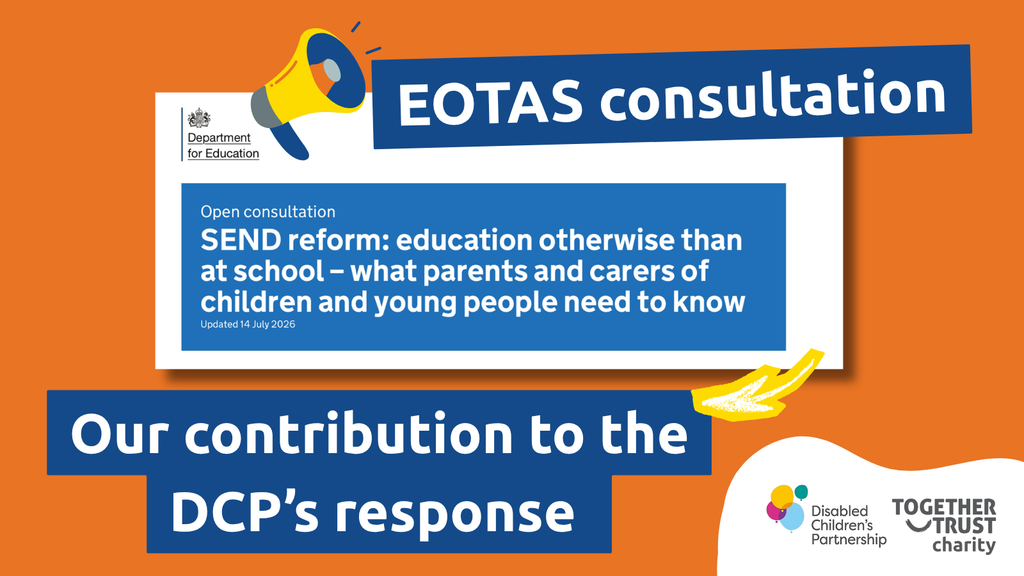
In our earlier blog, we explained the government’s consultation on Education Otherwise Than at School (EOTAS). In the consultation, the government asked how support, quality and oversight could improve for children educated outside school, including those receiving alternative provision because of health needs or through accredited online providers.
The consultation closed on 18 September 2026.
There are no immediate changes to existing arrangements. The DfE’s guidance for parents and carers states that any changes would take effect from 2029/30 at the earliest, subject to parliamentary approval.
Together Trust is a member of the Disabled Children’s Partnership (DCP). We joined professionals across the partnership to help develop its response, contributing our views on standards, transitions, online education and accountability. Our contribution was based on improving quality and accountability while protecting flexibility, with children’s and families’ experiences informing decisions about what support works for them.
National standards should be a starting point, not a cap
We broadly agreed that non-school alternative provision delivering EOTAS provision should be required to meet national regulatory standards, provided the standards are designed specifically for EOTAS, rather than simply applying an alternative provision framework to EOTAS.
Our response highlighted variation in how local authorities design, fund and oversee packages. Standards could help establish clearer expectations around safety, quality, staff expertise and meeting the needs in a child’s EHCP.
We also highlighted the risk in minimum standards becoming the maximum support available. We argued that standards should protect individualised provision rather than create identical packages or limit support which is already working well.
Returning to school is not the only measure of success
We argued that children returning to education should not always be treated as the ultimate goal. Pushing children back into education before they are ready, particularly where disability, trauma or anxiety affects attendance, presents a significant risk. Wellbeing, emotional safety, confidence and access to learning should all be viewed as being more important than fixed timelines or targets.
Where a return is appropriate, we called for gradual, flexible planning involving the child, their family and education, health and care professionals. Trusted adults, adjustments and contingency plans were central, including arrangements to avoid another lengthy wait for support if the transition does not work.
Online provision should reflect individual circumstances
We stated that placements through accredited online education providers should not be ended because of fixed deadlines, and should instead be reviewed around the child’s needs. For some, online learning may support a transition to another setting. For others, it may provide a longer-term route to education.
We are concerned that fixed limits assume another placement and support will be ready at the same time. Where arrangements do not align, children risk being left without education or moved to an unsuitable provision. Reviews must consider wellbeing, learning progress and whether the provision continues to meet the child’s individual needs.
Accountability needs to mean more than a name on a register
We did not support automatic school registration for every child receiving alternative provision through accredited online providers. This was not an argument against safeguarding or oversight. We questioned whether a school without meaningful involvement, sufficient resources or relevant expertise could provide that oversight effectively.
Instead, we called for a clearly identified body responsible for coordination, safeguarding, education planning, reviews, exams and communication with families. In many cases, we suggested this should be the local authority or another coordinating body. Remaining on a school’s register could work where that school is genuinely involved, and the arrangement suits the child.
What happens next?
The Department for Education will consider the feedback before deciding which proposals to take forward. A formal response should explain how people’s views have informed those decisions, although the consultation page does not yet give a publication date.
Stay up to date with our policy and campaigns work
- Sign up for our campaign updates to stay informed about the SEND reforms and our wider policy work.
- Share this blog on social media and tag Together Trust to help raise awareness.
- Check our website news for updates and other opportunities to take part.