
By Molly Deakin, Charity Policy and Campaigns Officer
Earlier this week, I attended Parliament for the launch of a new report by PBE (formerly Pro Bono Economics), commissioned by The Children’s Society: Prevention that pays: The economic case for early support for young people’s mental health and wellbeing.
The event was hosted by Helen Hayes MP, and Jon Franklin, Chief Economist at PBE, presented the report. Mark Russell, CEO of The Children’s Society, closed the event with a powerful speech calling for changes to policy and practice that would improve the lives of millions of young people, while also strengthening the economy in the years ahead.
These calls for earlier support are something we’ve heard again and again, from young people, their families, schools and charities. Hearing this speech, I sat there thinking: why are we still having to prove this? But the reality is, although this may seem obvious, the government are yet to invest in early prevention.
Simply put, children need support earlier. Not once they’re already in crisis. Not once have they stopped attending school. Not once has their mental health deteriorated to the point that the whole family is struggling.
This report looks beyond the moral obligations and underlines the economic benefits of early intervention.
So, what is actually in the report?
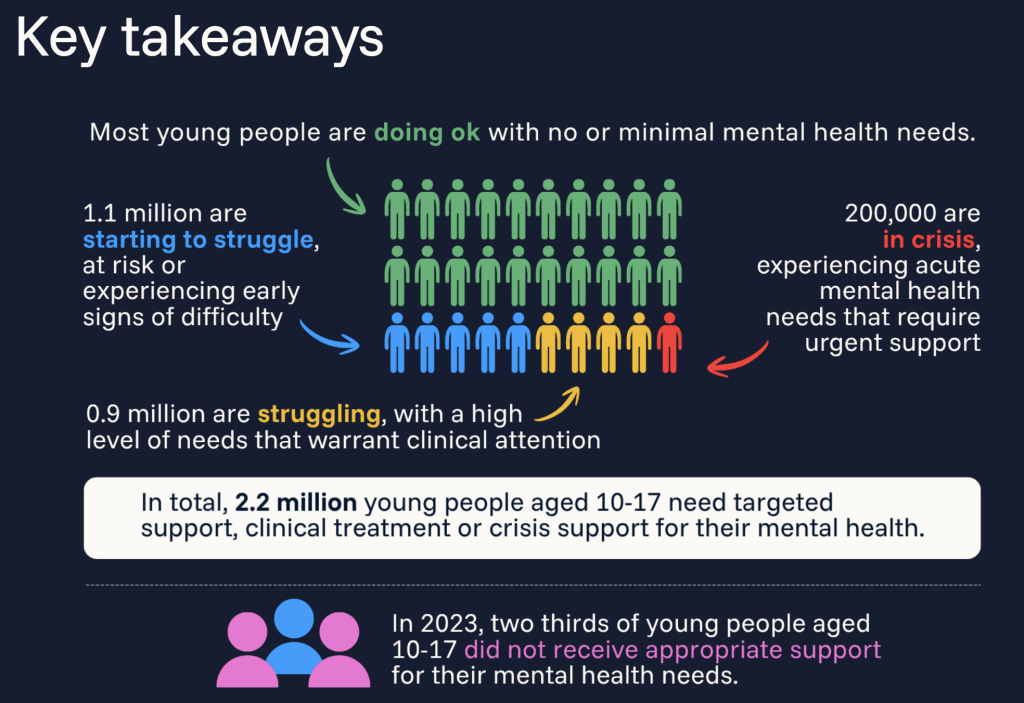
The report looks at the gap in mental health and wellbeing support for young people aged 10 to 17. PBE estimates that there are around 6.7 million young people in this age group in the UK.
- 200,000 children are in crisis
- 0.9 million are struggling with a high level of needs that warrant clinical attention.
- 1.2 million are starting to struggle, at risk or experiencing early signs of difficulty.
- Services have expanded in recent years, but not enough to keep pace with the growing need.
- Two-thirds of young people aged 10 to 17 did not receive appropriate support for their mental health needs in 2023.
- Around 740,000 young people were beginning to struggle but had no support.
- Many young people who had started struggling in 2022 had deteriorated further one year later, which shows why waiting until the crisis point is such a damaging approach.
PBE demonstrate the economic benefit of investing in early support. They estimate that expanding access to early mental health and wellbeing support could generate around £56 billion in economic benefits. This includes:
- Around £15 billion in increased lifetime earnings for young people
- More than £1 billion is linked to parents returning to work or working more productively
- Over £300 million in public service savings
- Around £39 billion in improved wellbeing for young people and parents
The investment needed to address the current gap is estimated at around £4.1 billion. That is a high upfront cost, but the modelling suggests society could see around £14 in benefits for every £1 invested. In plain terms, prevention is not simply nice to have for the quality of life of children and families; it’s a serious, evidence-based investment in the economy.
This report clearly demonstrates that this government must focus on early support so that young people receive the help they need before this escalates. There must also be much consideration given to improving the wider environment young people grow up in, for example, experiences at school, access to social media and poverty.
Why this matters
Prevention is too often framed as desirable but unaffordable; this report challenges that thinking. At Together Trust, we have been talking about the lack of preventative provision for a long time.
Across our services, we see what happens when support arrives too late. Families are left to navigate complex systems alone, schools are expected to fill gaps they are not resourced to fill, and children’s needs escalate while everyone waits for things to become “serious enough”.
If the government is serious about improving mental health, education, employment and economic growth, prevention has to move from the margins of policy into the centre of decision-making.”
Welfare reforms
While at the event, I was thinking about how preventative mental health care must be built into long-term government strategy before any serious consideration is given to reducing welfare support for people experiencing mental health difficulties.
When the government announced its intention to reform disability benefits, partly in response to the rising number of people claiming them due to mental health issues, many of us were saying the same thing: restricting access to benefits will not solve the problem. It does nothing to address why so many people are becoming unwell in the first place, why support is arriving too late, or why people are being pushed out of education and work.
If we support people earlier, improve their health and reduce crisis points, we reduce pressure on public services and create better long-term outcomes.
Simply cutting access to benefits may look like a saving on paper, but in reality, it pushes costs further down the line, leaving taxpayers to fund the consequences of untreated need.
Emotionally-Based School Avoidance
I kept thinking about the children and young people we speak to through our work on Emotionally Based School Avoidance (EBSA). EBSA describes children and young people who struggle to attend school because of emotional distress. For many, anxiety, sensory overwhelm, unmet SEND needs, bullying, trauma, or long waits for mental health support all play a role.
Early mental health support can significantly impact children’s lives and, in some cases, may prevent prolonged absence from school. It could help children stay connected to education, protect friendships, reduce family stress and support better long-term outcomes.
The report links better early mental health support with improved educational attainment, stronger labour market outcomes and higher lifetime earnings.
Why prevention must be built into the system
The government has taken some positive steps in recent years, including the expansion of school-based Mental Health Support Teams and the 10-year NHS plan. These initiatives are welcome – schools absolutely need better access to mental health expertise, and children should be able to access support in familiar, trusted places.
Yet, these efforts have not matched the scale of need. Demand continues to outpace capacity, and families are still facing long waits, rejected referrals and unclear pathways.
Looking at the wider policy landscape, including the NHS 10-year plan, welfare reform and forthcoming SEND reforms, it feels as though government can see the problem, but is still not ready to commit to the level of upfront investment needed for long-term, sustainable change.
For me, this report feels like a welcome breath of fresh air because it puts evidence behind something charities have been saying for a very long time: we cannot keep scratching the surface. If the government is serious about improving mental health, education, employment and economic growth, prevention has to move from the margins of policy into the centre of decision-making.