
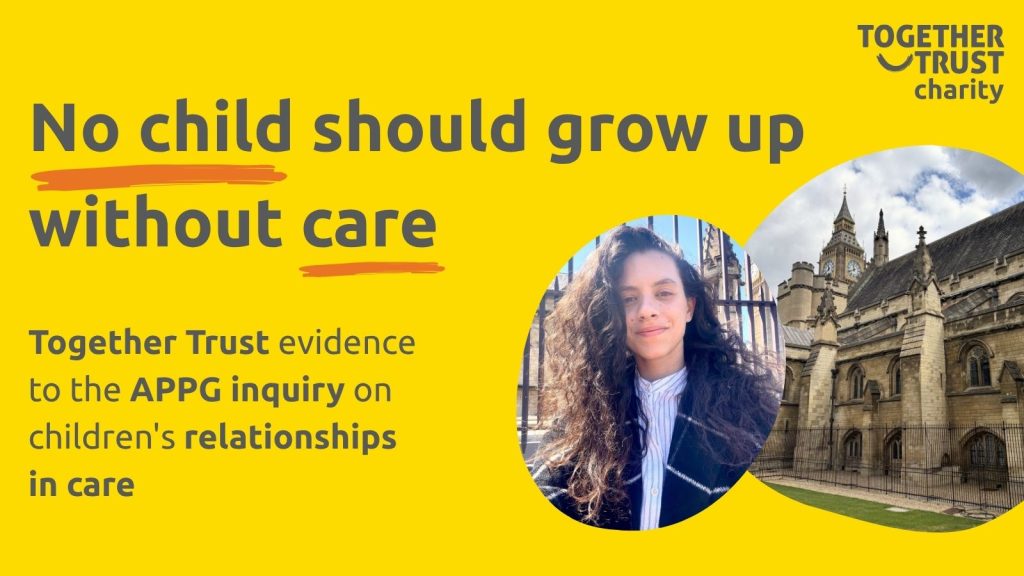
by Styliana Pasiardi, Policy and Campaigns Manager, Together Trust
On 9 June, I gave oral evidence to the APPG for Children in Care and Care Leavers as part of its inquiry into children’s relationships in the children’s social care system.
I was invited to join a panel focusing on supported accommodation and was incredibly grateful for the opportunity to advocate for the rights and needs of children in this important space.
Alongside giving oral evidence, we also submitted written evidence to the inquiry on the impact of illegal homes on children in care.
Our evidence on supported accommodation
Children need care, not just support
A key message from our evidence was that there are structural limitations within supported accommodation that mean providers cannot consistently guarantee that children will develop and maintain positive, healthy and enduring relationships.
Unlike children’s homes, supported accommodation is not designed to provide care. There is no requirement for staff to be present 24 hours a day and, in some cases, children may only see support staff once a week and a social worker once every six weeks. This fundamentally constrains relationship-building with the adults who are most important to their experience in care.
Evidence continues to raise concerns about safeguarding in supported accommodation. Children must feel safe before they can form trusting relationships, yet research and casework suggest this cannot always be guaranteed.
As highlighted by children themselves through a survey led by Article 39 as part of the Keep Caring to 18 campaign, what matters most are the relationships around them: having someone regularly around to chat to, someone who shows they care, and someone to support them through challenges and emergencies.
Children in supported accommodation often experience instability and repeated placement moves, disrupting their ability to build lasting relationships and friendships. Sibling separation is also significantly higher in supported accommodation than in foster care or kinship care, disrupting key emotional bonds and a sense of belonging.
Age is not a measure of readiness
We must move away from the current two-tier system, where many 16- and 17-year-olds are placed in settings without care, depending on where they live.
Children in care have diverse strengths and experiences, but many have also experienced significant adversity. They may appear outwardly independent while masking substantial unmet need.
Early adolescence is a critical period of psychological and social development. Children need love, care and trusted adults to help them navigate this period, and their needs can change depending on the challenges they face. As those needs fluctuate, it is vital that they live in homes where staff can legally provide the care they require, consistently.
Good providers can support children to develop and maintain positive, healthy and enduring relationships, but too often this depends on individual providers and staff rather than the system itself. As it stands, supported accommodation cannot consistently guarantee the stable, caring relationships children need.
Stability matters
Workforce challenges across children’s social care, combined with weaker regulation in supported accommodation than in children’s homes, can undermine children’s ability to build lasting relationships. High staff turnover and stretched services often mean children experience constant changes in the professionals around them.
At Together Trust, one of our priorities is to provide stability through staffing. In our children’s homes, many colleagues have worked with us for well over a decade, with some bringing more than 25 years of experience.
We know the difference this can make. One young person who left our care and later moved into supported accommodation continued to maintain contact with our team. Reflecting on those relationships, they said:
“I’ve got a lot of respect and love for the staff that cared for me. They are like my family. The manager is like a mother to me. Whenever I get anything new or achieve something, she’s the first one to call.”
Our evidence on illegal homes
In our written evidence, we highlighted the impact of illegal and unregistered homes on children’s ability to form safe, stable and trusting relationships. Operating outside formal oversight and standards of care, these illegal settings cannot guarantee access to consistent, suitably trained adults.
At Together Trust, we are often the first stable placement for children who come into our care. We know that when children are placed in settings that don’t guarantee the standard of care, they are left feeling isolated.
“We see properties being used as bases, young people congregating, older males attending, dealing drugs, antisocial behaviour, weapons [and] some of these placements have more in common with trap houses than care settings. You’ve got people coming and going, children going missing for days.” (Anglia Ruskin University)
Children placed in illegal settings are often those with the most complex needs. The Children’s Commissioner reports that 31% are subject to Deprivation of Liberty orders, reflecting a need for intensive, consistent and therapeutic relationships. Yet, many are left without the therapeutic care, stability and trusted relationships they require.
Evidence from the Children’s Commissioner points to emotionally cold and unstable settings, including Airbnbs, hotels and caravans staffed by agency workers. These are not conducive to building trust or a sense of belonging. Although intended to be short-term, placements often last for months or extended periods, prolonging uncertainty and preventing the development of sustained relationships with trusted adults.
The rapid growth of unregistered provision reflects wider pressures in the care system, but no child should be left effectively ‘out of sight’ in placements that fail to provide the safety, care and connection they deserve.
Between 2020 and 2024, there has been a reported 546% increase in illegal settings in England (Anglia Ruskin University). Together Trust FOI data (2020–2023) found children as young as 10 placed in illegal provision, with over £100 million spent annually. Around 89% of placements are delivered by private providers (Children’s Commissioner).
Children cannot build safe, trusting relationships when moved repeatedly, placed far from home or left without consistent adults around them.
What needs to change?
We called for:
- A clear, time-bound plan to phase out unregistered, illegal settings.
- A guarantee that all children in care receive regulated care until at least age 18.
- A national sufficiency and workforce strategy to increase high-quality, therapeutic and specialist provision.
- Improved national data collection on unregistered, illegal placements.
- Stronger multi-agency safeguarding approaches to protect children from harm.
‘‘Instability is not inevitable. It is the result of policy and practice choices, and it can be changed. Every child deserves safety, care, stability, love and trusted relationships. Most importantly, every child in care deserves someone firmly in their corner’’ Styliana Pasiardi, Policy and Campaigns Manager
Looking ahead
Over nine weeks, the APPG heard from more than 200 individuals and organisations, including over 150 care-experienced children and young people. In an updated the APPG said:
‘‘Over the summer, we’ll be reviewing the evidence and writing our report over with the aim of launching it at an event in Parliament this Autumn. We look forward to sharing further details about the event and report launch soon’’.